VoxCart AI · · 4 min read
How Conversational AI Is Changing Online Shopping Forever
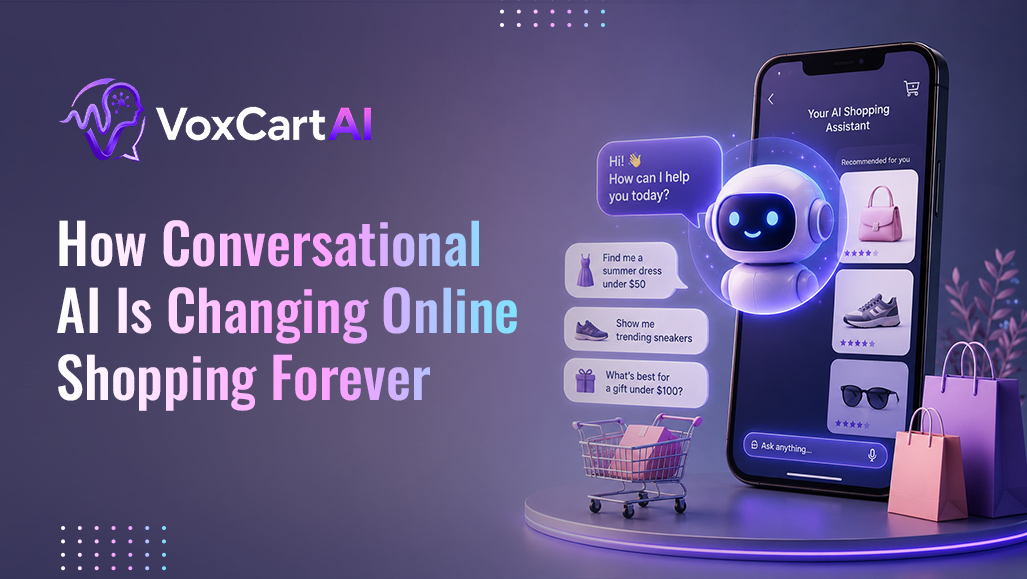
Seven out of ten shopping carts get abandoned, and wanting the product was never the problem. Something got in the way between wanting it and buying it.
Baymard Institute's latest meta-analysis puts the global average at just over 70 percent. A shipping cost that shows up too late. A question nobody's around to answer at 9 p.m. A checkout field that throws an error with no explanation. Every one of those is a moment where a real conversation would've closed the sale, and a search bar just couldn't. That gap is exactly what conversational AI is built to close.
Shopping was never supposed to be a form
Walk into a physical store with a question, and someone answers it on the spot. Shop online, and you're filling out a search box, scanning ten product pages, and hoping an FAQ page covers the one thing you actually need to know.
That gap between how people naturally ask questions and how ecommerce sites make them ask questions is where most of that 70 percent lives. Not indecision. Friction.

What 'conversational' actually changes
A search bar returns a list. A conversation returns an answer. Type "waterproof running shoes" into a search field and you get 200 results sorted by relevance, whatever that means this week. Ask a conversational agent the same thing, and it asks back: what terrain, what size, any brands you already like? Two exchanges later you're looking at three options instead of two hundred.
That's a fundamentally different interaction than a chatbot with better copywriting, because the system carries context from one question to the next instead of resetting after every click.
Where the conversation actually happens
Before the purchase, it's product questions a spec sheet can't answer well. Does this fit a narrow foot? Will it work with what I already bought last month? A real conversation handles both in one exchange.
During checkout, it's the moment things break. A card gets declined for no obvious reason, or a discount code won't apply, and the shopper is one frustrated click from leaving. A conversational agent catches that live, instead of losing the sale to an abandoned-cart email that gets opened three days later, if it gets opened at all.
After the purchase, it's the questions that used to sit in a support queue. Where's my order, can I still change the size, what's your return window. None of that needs a person reading a script. It needs someone, or something, that already knows the order.
Why voice changes the equation again
Text-based chat solved part of this. Voice solves the rest. Typing a question on a phone while standing in line is annoying enough that most people just don't bother, and the question goes unanswered, and the cart gets abandoned anyway.
Speaking the question takes five seconds. No typing, no waiting for a chat window to load, no picking through a dropdown of pre-written options that don't quite match what you're actually asking. That's the difference between a tool people use once out of curiosity and one they use every time something's unclear.
Some early data backs this up too. Stores testing AI-assisted shopping have reported order increases in the double digits, simply from answering the question a shopper would've otherwise left the site to search for. A missing answer costs a sale. A five-second answer keeps it.
What this looks like in practice
A shopper lands on a product page at midnight with one question: does this run small? They ask out loud instead of digging through 40 reviews looking for a mention of sizing. The agent already has the product data, answers in seconds, and the sale that would've been a tomorrow-maybe becomes a tonight-yes.
Multiply that by every product question, every checkout hiccup, every "where's my order" that used to sit in an inbox for six hours. That adds up to a different shopping experience, not a marginal improvement to the old one.
Where this is headed
Conversational AI in ecommerce is turning into the expected way to shop now, the same way free shipping went from a perk to a baseline in about a decade.
Stores that treat it as a nice-to-have will keep losing that 70 percent to friction nobody's fixing. Stores that build it in early get a shopping experience that actually answers back. If you're ready to see what that looks like on your own store, VoxCartAI's voice agent is built to have that conversation from the first visit to the last question after checkout.
Ready to add voice AI to your store?
Start free